

Quick answer: The best youth baseball drills are simple and repeatable: tee work and soft toss for hitting, ground ball and fly ball drills for fielding, and short-distance catch for throwing. Each drill should teach one thing, use about 10 to 15 reps, and stay fun. Mastering fundamentals matters more than doing many drills.
Key takeaways
- Pick a few drills and repeat them. Fundamentals come from reps, not variety.
- Hitting: start with the tee, then soft toss, then live pitching.
- Fielding: get low, field out front, and use two hands.
- Throwing: grip, side to the target, step, and finish. Keep catch short and relaxed.
- Keep sessions short and positive, and stop when focus fades.
What are the best youth baseball drills?
The best youth baseball drills are the ones that teach one skill at a time and can be repeated at home. For hitting, that means tee work and soft toss. For fielding, it means ground balls with good footwork and fly balls with a proper first step. For throwing, it means short-distance catch with a focus on grip and finish.
These are baseball fundamentals, the basic skills every player needs at every level. Coach Murphy Su’a, who has coached at the high school, college, professional and international levels for more than 40 years, still builds practices around them. The drills below are the same ones that fit a youth player in a backyard, a park or one of our free youth baseball clinics.
Each drill lists how to do it, what it fixes and how many reps to try.
Free for parents, coaches and players
Get the free drill pack
19 baseball and softball drills for hitting, fielding, throwing and pitching, plus a 60-minute practice plan. One printable PDF, sent to your inbox.
What are the best baseball hitting drills for kids?
Baseball hitting drills for kids should build balance, a short path to the ball and good contact. Start at the tee, where the ball sits still, then move to soft toss and live pitching as contact improves.
Tee work
- Set the tee in front of the plate at about belly-button height.
- Take a balanced stance with knees slightly bent and hands relaxed.
- Swing level and hit the ball out in front of the body.
- Hold the finish for a moment so you feel your balance.
What it fixes: balance, bat path and contact point. Reps: 15 to 20 swings, moving the tee in, out, up and down to match different pitch locations.
Soft toss
- A partner kneels about 5 to 6 feet away and to the side, slightly in front of the hitter.
- The partner tosses the ball underhand into the hitting zone.
- The hitter swings and drives the ball into a net or fence.
- Keep the head still and watch the ball all the way to the bat.
What it fixes: timing and eye-hand coordination. Reps: 10 to 15 tosses per round, two or three rounds.
One-hand drill
- Take a swing with only the top hand on a lighter bat or a short bat.
- Repeat with only the bottom hand.
- Return to a two-hand swing and keep the same feel.
What it fixes: hand path and control of the barrel. Reps: 5 swings with each hand, then 5 with both.
If your player is moving toward high school ball, we cover the swing in detail in our guide to baseball swing mechanics.
What are good fielding drills for young players?
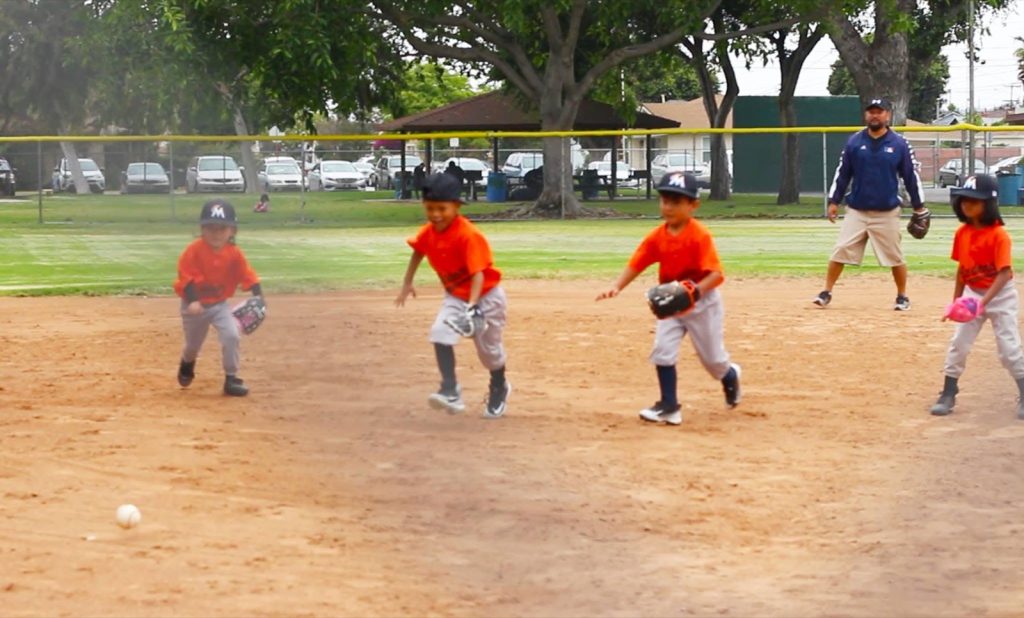
Good fielding drills teach a player to get low, stay in front of the ball and use two hands. Fielding is mostly footwork and habit, so slow, clean reps matter more than speed.
Ground ball basics
- Start in an athletic stance with feet wider than your shoulders, knees bent and glove out in front.
- A partner rolls the ball slowly from about 15 feet away.
- Move your feet to get in front of the ball and let your glove go to the ground.
- Catch the ball with the glove and cover it with the throwing hand.
- Bring the ball up to your chest and reset.
What it fixes: glove down, two hands and footwork. Reps: 10 to 12 rolls, then repeat to the left and right.
Fly ball drill
- A partner tosses a soft, high ball from about 20 feet away.
- The fielder takes a first step back or to the side, based on where the ball goes.
- Get under the ball and catch it above your head with both hands.
- Throw it back with a good grip and finish.
What it fixes: first step and tracking the ball. Reps: 8 to 10 catches, with a few going left and right.
Cone shuffle
- Place two cones about 10 feet apart.
- The player shuffles from one cone to the other, staying low with the glove out front.
- At each cone, the player pretends to field a ball and then shuffles back.
What it fixes: lateral movement and staying low. Reps: 5 trips each direction.
How do you drill throwing the right way?
Throwing drills should begin close to a partner and move back as accuracy improves. The goal is a clean grip, a turn of the body, a step at the target and a full finish.
Partner catch
- Stand about 20 to 30 feet from a partner.
- Grip the ball across the seams with two fingers and a thumb.
- Turn your side to the partner, step toward them and throw.
- Finish with your chest facing the target.
What it fixes: grip, footwork and accuracy. Reps: 15 to 20 throws, moving back a few steps only if throws stay on target.
Knee throws
Kneel on the back knee and throw to a partner, keeping the front foot pointed at the target. What it fixes: the arm path and upper body turn. Reps: 10 throws.
For a full step-by-step breakdown, read how to throw a baseball correctly. Whenever a young arm feels sore or hurts, stop and see a doctor or athletic trainer. For pitchers, follow MLB and USA Baseball’s Pitch Smart guidelines on pitch counts and rest.
How should a youth practice be organized?
A good youth practice moves quickly, changes stations often and ends on something fun. Short blocks keep kids focused and make every minute count.
Here is a simple 60-minute plan that works for parents and volunteer coaches:
- 10 minutes: Warm-up. Jog, stretch and play easy catch.
- 15 minutes: Throwing and catching drills.
- 15 minutes: Fielding drills in small groups.
- 15 minutes: Hitting stations with tee, soft toss and live swings in rotation.
- 5 minutes: A short game or relay, then cool down.
Keep the groups small so every player gets many reps. Give each player one thing to work on, and praise effort, not just results.
What should parents watch for during drills?
Parents should watch for effort, balance and enjoyment more than results. A player who keeps trying and smiles will keep improving.
- Look for balance. A hitter who falls off the swing needs a stronger base.
- Look for the feet. Most fielding and throwing problems begin with the feet.
- Watch the finish. A good finish means the whole body is working.
- Keep feedback short. One cue at a time is plenty.
If your player is preparing for a team, our guide to baseball tryouts explains what coaches look for. For players who want more focused work, one-on-one player development is available with Coach Su’a for high school, college and professional baseball and softball players.
Frequently asked questions
How long should a youth baseball practice last?
Sixty to ninety minutes works well for most youth teams. Younger players may need less. Change stations often, keep reps high and stop when focus fades. A short, active practice teaches more than a long one.
What baseball drills can my child do at home?
Tee work, soft toss with a partner into a net, short catch in the yard and ground balls rolled across the grass are all easy at home. Pick two or three and repeat them a few times each week.
How many swings should a young hitter take in a session?
Fifteen to thirty good swings is plenty for most young hitters. Quality matters more than volume. Stop when swings get sloppy or the hitter loses balance.
At what age should a child start baseball drills?
Children can start with simple catch and tee swings as soon as they show interest. Keep it playful for younger kids and add structure as they get older and want to improve.
Are baseball and softball drills the same?
Many are close, such as fielding footwork and tee work. Pitching and some swing details differ. Coach Su’a coaches both sports, and our clinics will welcome baseball and softball players of all ages.
Where can my child practice drills with coaches in the South Bay?
DITR is planning its next season of free baseball and softball clinics for all ages in the Torrance and South Bay area. Coaches lead players through fundamentals in small groups. You can get updates on our clinic page.
Sources and further reading: MLB Pitch Smart
Practice with coaches at a free clinic (coming soon)
Come work on hitting, fielding and throwing with DITR coaches. Get free clinic updates.